
What Is Oleocanthal — And How to Tell If Your Olive Oil Actually Has It
What Is Oleocanthal — And How to Tell If Your Olive Oil Actually Has It
That peppery bite at the back of your throat isn't a flaw. It's a fingerprint. When you swallow a mouthful of high-quality extra virgin olive oil and feel a brief, sharp catch — the kind that almost makes you cough — you're experiencing oleocanthal, the compound researchers have spent the last two decades studying for its anti-inflammatory properties. Most olive oils don't have enough of it to register. A few do. Here's how to tell the difference.
The Compound Behind the Catch
Oleocanthal is a polyphenol — specifically a secoiridoid — found almost exclusively in fresh, high-quality extra virgin olive oil. Its name was coined in 2005 when scientists at the Monell Chemical Senses Center noticed that freshly pressed EVOO produced the same throat-irritation sensation as liquid ibuprofen. That parallel wasn't cosmetic. Follow-up research confirmed that oleocanthal inhibits COX-1 and COX-2 enzymes — the same biological pathway that non-steroidal anti-inflammatory drugs target.
A 2005 paper in Nature estimated that 50 ml of high-oleocanthal EVOO per day delivers roughly 10% of the anti-inflammatory effect of an adult ibuprofen dose. That's not a cure, but it is a measurable biological mechanism — and it's exactly what researchers mean when they talk about the Mediterranean diet's "anti-inflammatory effect."
To be clear: oleocanthal isn't a medicine. But it is a real, quantifiable compound with documented mechanisms. The difference between an oil that has it and one that doesn't is the difference between a functional food and a flavored fat.
How to Do the Sensory Test Right Now
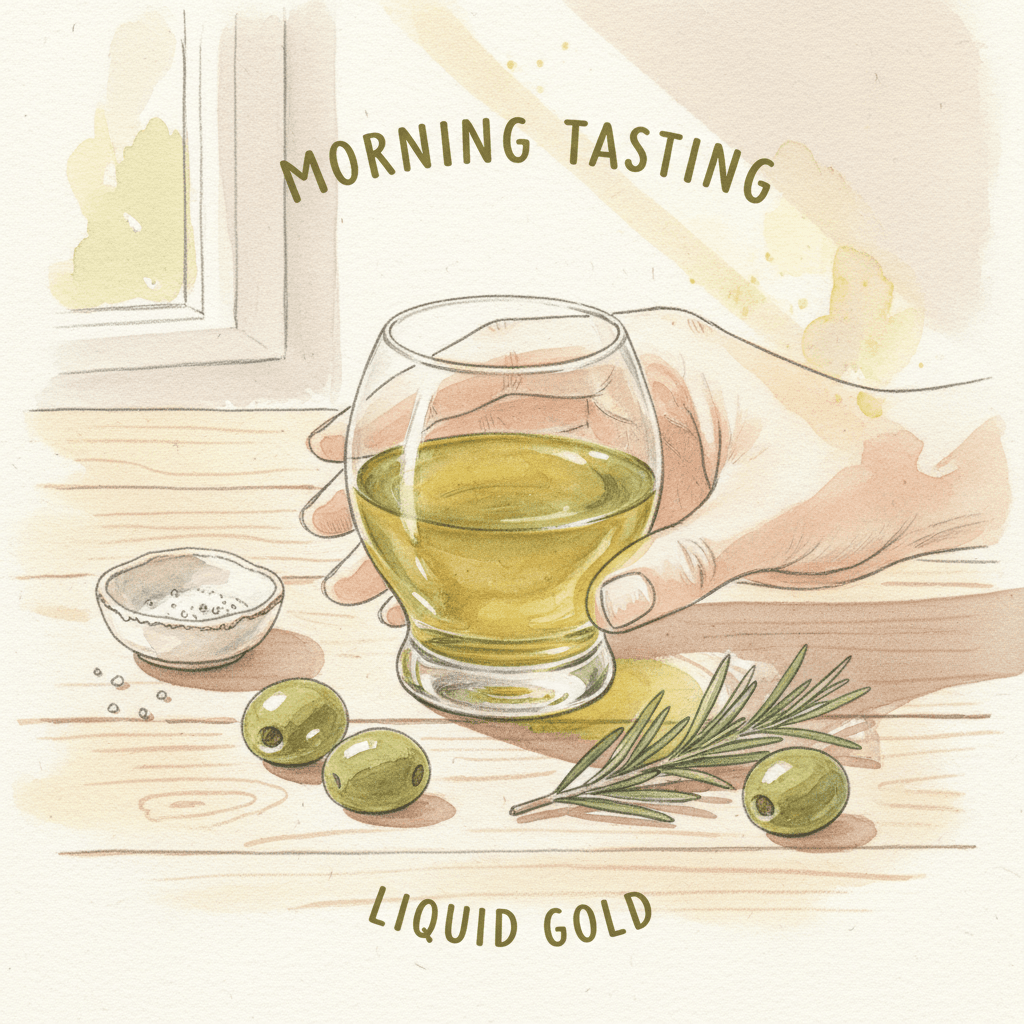
You don't need a lab to confirm oleocanthal is present — your throat is a surprisingly reliable detection instrument. This is the standard tasting protocol used by professional olive oil judges:
- Pour about a tablespoon into a small juice glass. A narrower opening concentrates the aroma.
- Warm it with your palm for 20–30 seconds. Temperature brings volatile compounds forward.
- Inhale slowly. You should pick up green grass, fresh-cut apple, or stone-fruit pit. Bland or waxy means the oil is old or low quality.
- Take a single slow sip. Let it coat your tongue. Hold for three seconds.
- Swallow and wait. Oleocanthal makes itself known two to three seconds after swallowing — a distinct peppery sting at the back of the throat, not on the tongue.
One cough: good. A sharp double-catch: very good. Zero sensation: the oil has little to no oleocanthal.
Professionals in olive oil competitions rate this throat catch on a scale of 0–5. It's called picante, and it's a quality signal, not a defect. If a producer or retailer tells you the pepper "means the oil is too strong," they're confusing freshness with harshness. Walk away.
Why Most Supermarket Oils Don't Have It
Oleocanthal degrades quickly. It begins dropping within weeks of pressing, accelerates with heat, and is highly sensitive to light exposure. Most supermarket EVOO spends six to twelve months in a supply chain before it reaches a shelf — often in a clear glass bottle under fluorescent lighting. By the time you open it, the oleocanthal content is negligible, even if the label says "extra virgin."
Two additional factors strip oleocanthal from mass-market oils:
- Blending across harvests and origins. Large-format brands blend oils from multiple countries and seasons to achieve a consistent flavor profile year-round. Freshness — and oleocanthal content — are sacrificed for shelf stability and supply predictability.
- Late-season harvesting. Olives picked later in the season (riper, larger) produce more oil per kilo but significantly less oleocanthal. Early-harvest olives, pressed within 24 hours, yield smaller volumes with dramatically higher phenolic content.
The Arbequina variety is sometimes perceived as lower in polyphenols than pungent cultivars like Picual or Koroneiki. That reputation is based on bulk production. In early-harvest, small-batch Arbequina pressed at peak ripeness, the polyphenol profile — including oleocanthal — climbs substantially. Varietal character and harvest timing interact; you can't judge one without knowing the other.
Reading the Numbers
Oleocanthal isn't measured separately on most lab certificates, but total polyphenol count is a reliable proxy. The EU's health-claim regulation (Regulation 432/2012) sets 250 mg/kg as the threshold for antioxidant-related label claims. Most supermarket EVOO tests between 50 and 180 mg/kg by the time it reaches consumers.
Quick benchmark:
- Typical supermarket EVOO at shelf: 50–180 mg/kg
- EU health-claim threshold: 250 mg/kg
- Angelica's November 2025 harvest: 349 mg/kg
Our 2025 Arbequina tested at 349 mg/kg total polyphenols — 40% above the EU threshold, and well into the range where oleocanthal registers clearly on the sensory test. The 0.14% acidity confirms the oil was cold-pressed from undamaged, freshly harvested fruit; oxidative damage that destroys polyphenols also raises free fatty acid levels. Low acidity and high polyphenols tend to arrive together — and leave together when the oil is old.
The old-timers who pressed oil from Arbequina groves before lab certificates existed knew the good batches by exactly that throat catch. The science has simply given a name to what they were already tasting.
Four Things to Look for When You Buy
Not every producer publishes polyphenol counts, but you can still narrow the field quickly:
- A harvest date on the label — not a "best by" date. If the producer won't say when the olives were pressed, treat the omission as a red flag.
- A polyphenol count above 250 mg/kg — the EU threshold is a useful floor. Above 300 mg/kg is genuinely high; above 350 mg/kg is exceptional and rare in Arbequina.
- Acidity below 0.3% — real EVOO sits well below the 0.8% legal ceiling. Sub-0.2% signals fast milling from undamaged fruit with minimal oxidation.
- The sensory test — run the throat-catch protocol above. If there's no sting, no amount of label marketing changes what's in the bottle.
Supermarket shelves are full of olive oils that pass the legal definition of extra virgin while failing every sensory and chemical indicator that makes EVOO worth using. Knowing what oleocanthal is — and how to find it with a tablespoon and thirty seconds — is the fastest way to close that gap. Find an oil that passes the test and stock it accordingly.
Salud!
Taste the Difference
Angelica's Organic Extra Virgin Olive Oil
100% Arbequina olives, cold-pressed in California. Small-batch, limited quantity.
Get Your BottleYou Might Also Enjoy
Baking with Olive Oil: How to Substitute Arbequina EVOO for Butter (With Real Ratios and Results)
# Baking with Olive Oil: How to Substitute Arbequina EVOO for Butter (With Real Ratios and Results) Oil-based cakes stay moist three to four days longer than butter-based ones. That's not a marketing

The 2026 Longevity Research on EVOO: What New Clinical Studies Actually Found
# The 2026 Longevity Research on EVOO: What New Clinical Studies Actually Found A multicenter trial published earlier this year tracked 4,800 adults over three years and found a 14–22% reduction in a

Why California EVOO Is More Trustworthy Than Most Imported Bottles (And What the Fraud Data Shows)
# Why California EVOO Is More Trustworthy Than Most Imported Bottles (And What the Fraud Data Shows) Forty-three percent. That's the share of extra virgin olive oils tested by the UC Davis Olive Cent