
Why California EVOO Is More Trustworthy Than Most Imported Bottles (And What the Fraud Data Shows)

Why California EVOO Is More Trustworthy Than Most Imported Bottles (And What the Fraud Data Shows)
Forty-three percent. That's the share of extra virgin olive oils tested by the UC Davis Olive Center in 2026 that failed to meet EVOO's own quality standards — either on chemistry, sensory evaluation, or both. Seventeen percent contained undeclared seed oils: sunflower, canola, soybean. They were sold as extra virgin. They were labeled with Italian piazzas and Tuscan hillside imagery. Many were priced as premium products.
This is not a minor labeling gray area. It's systemic adulteration. Understanding why it happens — and how California EVOO sidesteps most of it — is worth a few minutes before you reach for your next bottle.
Why "Extra Virgin" Is a Harder Claim to Fake in California
The term extra virgin olive oil has an international legal definition: acidity below 0.8%, zero flavor defects, produced without chemical refining or heat. The problem is enforcement. The IOC sets international standards, but within the U.S., no single federal agency consistently pulls bottles off shelves and tests them against those specs.
California is different. The California Olive Oil Council (COOC) runs a certification program with standards stricter than both the IOC and USDA benchmarks. COOC-certified oils must pass both chemical analysis and blind sensory panel evaluation by trained tasters — a dual gate that eliminates oils that are technically legal but practically mediocre. For participating growers, there is a paper trail from grove to bottle.
That paper trail matters. A 2024 IOC consumer survey found that 68% of U.S. olive oil buyers aged 28–45 would pay a 22% premium for oils with batch-level traceability data. The willingness to pay exists precisely because those shoppers have started to understand that "certified" means something different from "labeled."
The Origin Label Trap Most Shoppers Fall Into
Here's something your bottle won't tell you: "Product of Italy" does not mean Italian olives. Under EU law, an oil can carry a country's name if it was bottled there — even if the olives came from Tunisia, Greece, or Spain. Bulk oil from North Africa, shipped to an Italian filling facility, emerges legally labeled as a product of Italy.
This isn't an indictment of all imported oil — single-estate Italian, Greek, and Spanish producers make exceptional work. But the labeling system creates structural cover for blenders who mix low-cost commodity oil with higher-cost oil, bottle it at a recognized origin address, and sell it at a premium price.
The tells are usually visible if you know what to look for:
- No harvest date. Premium oil prints the harvest date, not just a "best by" window. A "best by" date is calculated backward from a buffer that benefits the seller, not the buyer.
- No acidity stated. Brands that don't print acidity usually have something to hide. At 0.14%, our Arbequina sits well below the 0.8% legal ceiling — closer to the sub-0.2% range where truly fresh, same-day-milled oil lives.
- No variety or estate name. "100% pure olive oil" or "extra light" signals refined oil, not extra virgin. Single-variety oils from a named estate are significantly harder to adulterate without laboratory detection.
Industry benchmark: The EU's official health-claim threshold for polyphenols is 250 mg/kg. Most supermarket EVOO tests between 50–150 mg/kg by the time it reaches a U.S. shelf. Half-life starts the day it's pressed; transit time, warehouse storage, and retail shelf time chip away at the count relentlessly.
What Single-Estate, California-Grown Actually Means
When we say single-estate, we mean: one grove, one varietal, one season. No co-mingling with oil from other growers. No blending of older and newer harvests to standardize flavor. Every bottle is traceable to the exact harvest — our November 2025 Arbequina pick — and carries the chemistry to prove it.
Our 2025 harvest came in at 0.14% acidity and 349 mg/kg polyphenols. The acidity figure reflects olives milled within hours of harvest, before cellular breakdown has had a chance to push free fatty acids higher. The polyphenol figure sits well above the EU's clinical threshold and well above what most bottled EVOO carries at any point in its shelf life.
Arbequina is a mild, buttery varietal — lower in bitterness than Picual or Koroneiki — with a flavor that leans toward ripe stone fruit and fresh almonds with a clean peppery finish. It's the most widely planted cultivar in California and thrives in the Central Valley's warm days and cool nights. At small-batch scale, it's picked at peak ripeness and pressed the same day.
That same-day processing window is something a small, single-grove operation can do that a large industrial mill simply cannot. It's the same instinct Grandma Angelica built this brand around: when volume is limited and quality is the whole story, the incentive structure changes entirely.
A Practical Checklist for the Next Bottle You Buy
Wherever you source your olive oil — California, Spain, Greece, anywhere — these are the signals worth evaluating:
- Harvest date on the label — not just a "best by" date
- Acidity stated — look for below 0.2%; anything above 0.5% is a yellow flag
- Polyphenol count — above 250 mg/kg meets the EU health-claim threshold; 300+ is excellent
- Single variety or single estate — traceable; significantly harder to adulterate
- Dark glass bottle — UV light accelerates oxidation; clear bottles are a quality red flag
- COOC or equivalent certification for California oils; a named DOP or PDO for imports
Sensory check: Pour about a tablespoon into a small glass. Warm it in your palm for 30 seconds. Fresh EVOO should smell like green grass, fresh tomato leaves, or stone fruit — not musty nuts, wax crayons, or nothing at all. Taste it: slight bitterness and a peppery catch at the back of your throat are signs the polyphenols are still present and active.
The 34% year-over-year increase in consumer spending on certified, high-polyphenol EVOO — tracked in the NAOOA's most recent Consumer Trends report — tells its own story. Buyers are educating themselves. The oils worth purchasing make verification easy.
Our small-batch, limited quantity California Arbequina is available while the 2025 harvest lasts. The specs are on the label. The chemistry is on file.
Salud!
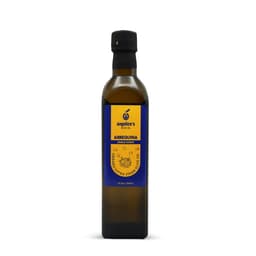
Taste the Difference
Angelica's Organic Extra Virgin Olive Oil
100% Arbequina olives, cold-pressed in California. Small-batch, limited quantity.
Get Your BottleYou Might Also Enjoy
Baking with Olive Oil: How to Substitute Arbequina EVOO for Butter (With Real Ratios and Results)
# Baking with Olive Oil: How to Substitute Arbequina EVOO for Butter (With Real Ratios and Results) Oil-based cakes stay moist three to four days longer than butter-based ones. That's not a marketing

The 2026 Longevity Research on EVOO: What New Clinical Studies Actually Found
# The 2026 Longevity Research on EVOO: What New Clinical Studies Actually Found A multicenter trial published earlier this year tracked 4,800 adults over three years and found a 14–22% reduction in a

How to Use EVOO as a Finishing Oil (And Why Your Best Bottle Should Never Touch High Heat)
# How to Use EVOO as a Finishing Oil (And Why Your Best Bottle Should Never Touch High Heat) A 2022 study published in *Antioxidants* found that heating EVOO to 180°C (356°F) for just 25 minutes redu